
Below are lists of two types of books that may help you in your personal career development. Reading through some of these may make you aware of career paths you'd never considered, and provide new directions for your career exploration. However, especially with older books, make sure to check the informaiotn with more recent data, as yesterday's hot career is today's dead end. 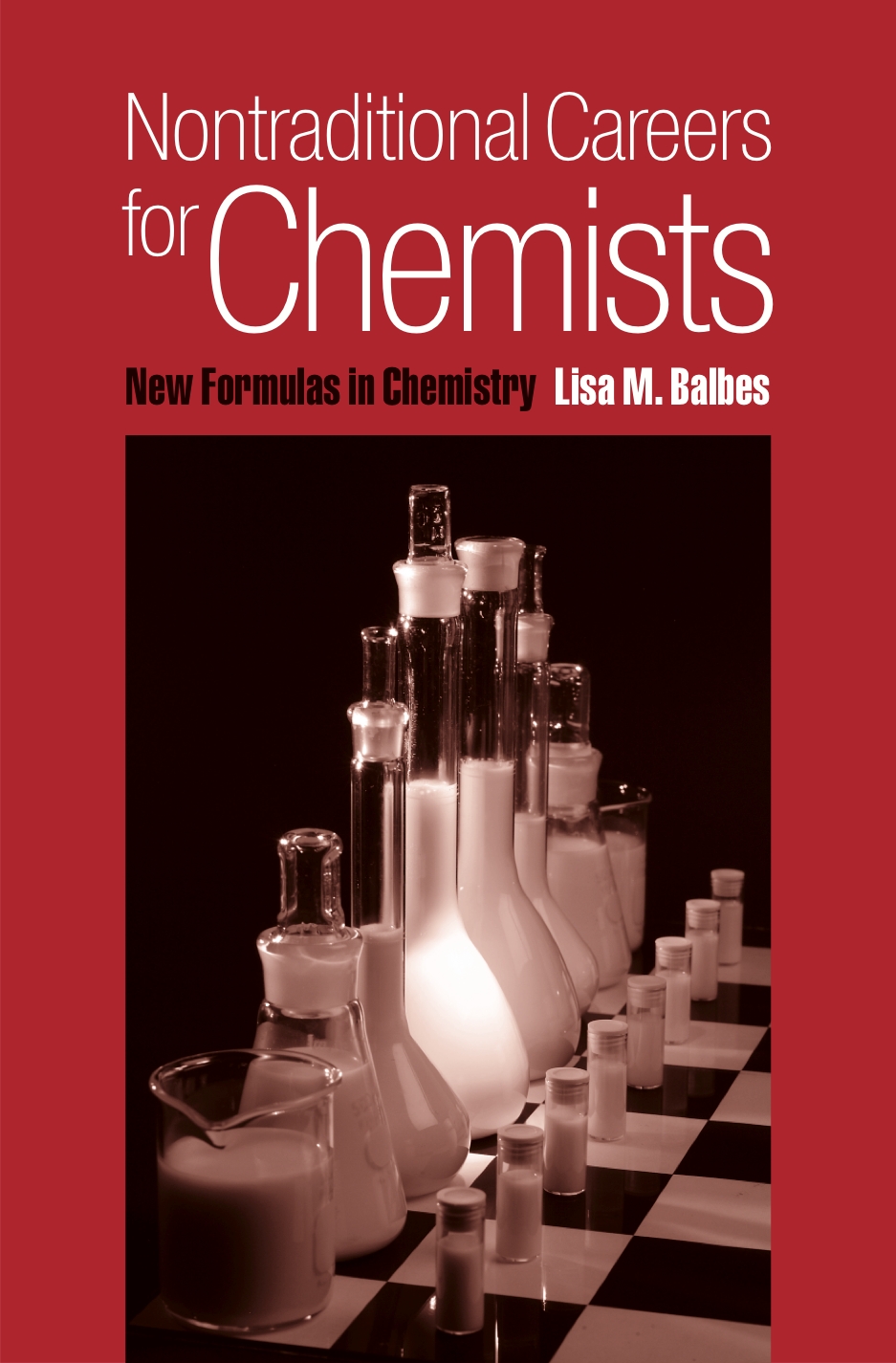
Of course, I am completely prejudiced and believe the best book out there is Nontraditional Careers For Chemists: New Formulas for Chemistry Careers, by Lisa M. Balbes, published by Oxford University Press (2007). This book covers careers in communication, information science, patents, sales and marketing, business development, regulatory affairs, public policy, safety, humna resources, computers, education and more. It includes a description of each field, profiles of multiple people in each field, and advice for those interested in getting started. (Electronic version now available from Google Play)
Other people like it too!
Advancing Healthy Populations: The Pfizer Guide to Careers in Public Health, Edited by Barbara Debuono and Hugh Tilson, 2002.
Profiles of 30+ people in variou public health careers.
All in a Day's Work: Careers Using Science, Megan Sullivan, NSTA Press, 2007
Brief descriptions of 30+ carers that involve science, as examples for high school students.
Alternative Careers in Science: Leaving the Ivory Tower, Cynthia Robbins-Roth, 2nd Edition, Academic Press, 2006.
Aimed at graduate students, includes detailed first-person narratives from scientists who have moved into nontraditional careers.
Career Development in Bioengineering and Biotechnology, Madhavan, Oakley and Kun, Editors, Springer, 2008.
Covers traditional and nontraditional careers, with first-person narratives. Also includes sections on career development, ethics, and professional responsibilities.
Career Management for Scientists and Engineers, John Borchardt, Oxford University Press, 2000.
A personal career mentor and roadmap in printed form.
Career Opportunities in Biotechnology and Drug Development, Toby Freedman, Cold Spring Harbor Press, 2008.
Breaks the drug discovery process down into its developmental stages, describes the role of each step in the process, and details career paths at each stage.
Career Opportunities in Clinical Drug Research, Rebecca J Anderson, Cold Spring Harbor Laboratory Press, 2010.
Descriptions of science careers all along the clinical drug research spectrum.
Career Opportunities in Science, Susan Echaore-McDavid, Checkmark Books, 2003.
Detailed descriptions of over 80 possible career paths for scientists.
Career Renewal, Stephen Rosen and Celia Paul, Academic Press, 1998.
Case studies, useful worksheets for self-exploration, not specific to scientists.
Career Transitions for Chemists, by Rodmann, Bly, Owens, Anderson, ACS Press, 1995.
Self career-counseling guide for chemists facing a transition.
Careers for Chemists: A World Outside the Lab, Owens, Uhler, Marasco, ACS Press, 1997.
Brief descriptions of and profiles of chemists in nontraditional careers.
Careers in Science and Engineering: A Student Plannnig Guide to Grad School and Beyond, National Academy of Sciences, 2006.
Free download from http://nap.edu/catalog.php?record_id=5129
Guide for students planning non-academic careers.
Careers with the Pharmaceutical Industry by Peter D. Stonier (Editor), John Wiley & Sons; 2nd edition, 2003.
Describes many classes of careers, both laboratory and non-laboratory based. UK based, so terminology and regulatory details are different.
The Chemist's Companion Guide to Patent Law, by Chris P. Miller and Mark J. Evans, published by J Wiley, 2010.
Embracing Your Practice: The Pfizer Guide to Careers for Physicians, Edited by S. Giorgianni, 2002.
Detailed profiles of 30 medical practice specialists.
Full Preparation: The Pfizer Guide to Careers in Pharmacy, Edited by Salvatore Giorgianni, 2002.
Great Jobs for Chemistry Majors, Rowh, McGraw-Hill, 1999.
General job searching advice, as well as list of traditional careers (reasearch, teaching, management and support), aimed at undergraduate students.
Guide to Non-Traditional Careers in Science, Karen Young Kreeger, Taylor & Francis, 1999.
Covers science education, illustration and imaging, writing/editing/publishing, informatics, tech transfer, business, law, science policy with introductions, short interviews, and resource lists.
Jobs in the Drug Industry - a Career Guide for Chemists, Richard Friary, Academic Press, 2000.
Descriptions of the types of jobs in the pharmaceutical industry, and some general career advice icluding how to evaluate companies.
Jump Start your Career in BioScience, Chandra Louise, Peer Productions, 1998.
Aimed at undergraduate students, broad survey of potential careers opportunities with general advice on how to find them.
Mastering Your PhD, by Gosling and Noordam, Springer, 2006.
Guide to making the most of graduate school, from how to think like a scientist to how to make the most of conferences.
Opportunities in Biotechnology Careers. Sheldon S. Brown, VGM Publisher, 2000.
Opportunities in
Biological Science Careers. Sheldon S. Brown, McGraw Hill, 2007.
Opportunities in Chemistry Careers. John H. Woodburn, VGM Publisher, 2002.
Opportunities in Forensic Science Careers, Blythe Camenson, VGM Publisher, 2004.
Overview of the field, list of job titles, suggested college classes.
A Ph.D. is Not Enough, Peter Feibelman, Addison Wesley, 1993.
Chosing an advisor, oral presentations, paper writing, industry vs. academia, interviews, getting funding.
Planning a Scientific Career in Industry, Mohanty and Ghosh, Wiley and Sons, 2010.
Introduction to industry and advice for a successful career there.
Put Your Science to Work: The Take-Charge Career Guide for Scientists, Peter Fiske, American Geophysical Union, 2001.
Resources, general job searching skills, resume vs. CV. Lots of examples, some ideas for non-traditional careers.
The Scientist as Consultant, Carl Sindermann and Thomas Sawyer, Plenum Press, 1997.
For scientists who are considering consulting, and want to know what it’s really like.
To Boldly Go: A Practical Career Guide for Scientists, Peter S. Fiske, AGU Press, 1996.
Career planning for scientists, especially those who want to make a change.
What Color is Your Parachute? A Practical Manual for Job-Hunters and Career-Changers, Richard Bolles, Ten Speed Press, 2013.
Also has a Job-Hunter's Workbook Third Edition 2010) and
Know yourself, figure out what you want to do, then find that job. Not specific for scientists, but useful for those who really have no idea where to start in defining their career.
Reviews of Nontraditional Careers For Chemists: New Formulas for Chemistry Careers:
Questions about this web site should be sent to webmaster@balbes.com.
Copyright 2015, Balbes Consultants. World Headquarters at 648 Simmons Avenue, Kirkwood MO 63122 USA.